What Causes Autism in Children and What Parents Should Know
If you are searching what causes autism in children, you may be trying to make sense of a child's communication, social, sensory, or behavior patterns. The most honest answer is that autism spectrum disorder does not have one simple cause. Current research points to a mix of genetic influences, early brain development, and some prenatal or birth-related risk factors. Risk does not mean blame, and it does not mean a parent did something wrong. If you are noticing traits and want a calm first step, an ASD screening and reflection tool can help you organize observations before discussing concerns with a qualified professional.

The Short Answer: Autism Usually Has More Than One Cause
Autism is a neurodevelopmental difference, which means it is connected to how the brain develops and processes information. For many children, there is no single event that explains why autism appears. Instead, several influences may combine before or around birth, long before a parent notices signs such as delayed speech, reduced eye contact, intense interests, repetitive movements, sensory sensitivities, or difficulty with changes in routine.
A helpful way to think about causes is to separate three ideas:
- Genetic contribution: inherited or new genetic variations can affect brain development.
- Early brain development: differences in how brain cells connect, communicate, and organize may shape autistic traits.
- Environmental risk factors: some prenatal, birth, and early-life conditions may raise risk, especially when combined with genetics.
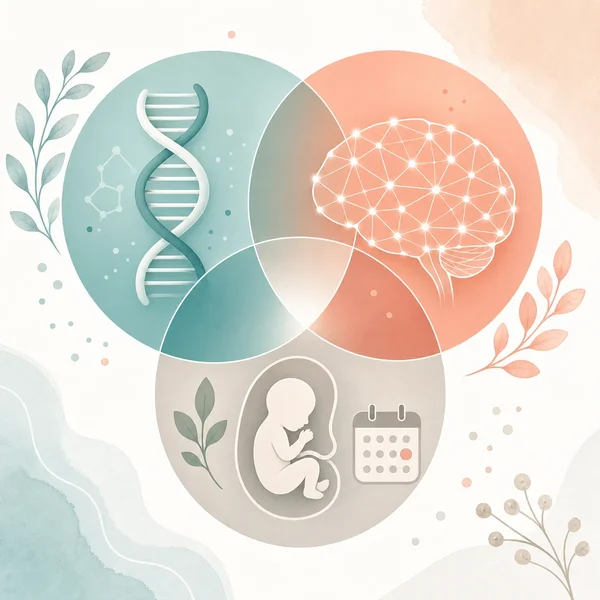
None of these categories works like a switch. A child can have a genetic variation and not be autistic. Another child can have no known genetic explanation and still meet autism criteria in a formal assessment. This is why responsible autism information uses words like "risk," "associated with," and "may contribute" rather than claiming one certain cause.
Genetics Are the Strongest Known Influence
When people ask what is the strongest cause of autism, genetics is usually the clearest answer. Autism often runs in families, and research has found many genetic variations associated with autism risk. Some are inherited from one or both parents. Others are new variations that occur in reproductive cells or very early development.
This does not mean there is one "autism gene." In most cases, autism appears to involve many genes, each contributing a small part of risk. In a smaller group of children, autism may be linked with a known genetic or chromosomal condition such as fragile X syndrome, Rett syndrome, tuberous sclerosis, or another condition that also affects development.
It also does not mean one parent "carries" autism in a simple way. A child receives genetic material from both biological parents, and some genetic changes are not inherited from either parent. If a family has one autistic child, the chance of another child being autistic is higher than in the general population, but the exact risk depends on the family history and the child's broader developmental profile.
For parents, the practical takeaway is not blame. It is context. If there are developmental differences, language delays, seizures, intellectual disability, strong family history, or other medical findings, a pediatrician or specialist may suggest genetic counseling or testing as part of a broader evaluation.
What Causes Autism in Children During Pregnancy?
Many searches about autism causes focus on pregnancy. That makes sense because autism begins with early brain development, but it is important to be precise: pregnancy risk factors are not the same as visible "signs of autism during pregnancy." There is no reliable way to observe autism traits in a fetus through ordinary pregnancy symptoms.
Researchers study prenatal factors because the developing brain is sensitive to genetics, biology, and the surrounding environment. Factors that have been associated with higher autism risk in some studies include advanced parental age, very preterm birth, very low birth weight, certain birth complications, maternal metabolic or immune conditions, and some prenatal exposures such as air pollution or pesticides. Some infections, medications, or serious health complications during pregnancy may also be studied as possible contributors.
These factors should be understood carefully. Most children exposed to a risk factor do not develop autism, and many autistic children have no obvious prenatal risk factor. A risk factor may slightly increase probability across a population without explaining one child's full story.
For expectant parents, the best response is general prenatal care rather than fear. Regular medical visits, discussing medication questions with a clinician, managing chronic conditions, avoiding known toxins when possible, and seeking support for pregnancy complications are sensible for many health reasons. They cannot promise to prevent autism.
What Causes Autism in the Brain?
Autism is linked to differences in brain development, but the brain explanation is still complex. Scientists study how neurons form connections, how different brain regions communicate, how gene activity affects development, and how sensory, language, attention, and social-processing systems mature over time.
In everyday life, these brain-based differences may show up as a child who communicates differently, prefers routines, repeats movements or phrases, reacts strongly to sounds or textures, focuses intensely on specific interests, or struggles with flexible social play. These are not character flaws. They are possible signs that the child's brain is processing information in a different pattern.
Brain development is also one reason autism varies so widely. One child may speak early and still have major sensory or social challenges. Another may have delayed language and need substantial daily support. Another may appear to cope at school but melt down at home from accumulated social and sensory effort. The same broad label can include very different support needs.
If a parent is trying to understand observations, a structured ASD self-reflection can help collect examples across communication, social interaction, sensory patterns, and routines. That kind of organized note-taking is often more useful than trying to identify one dramatic cause.
Environmental Causes of Autism: What the Phrase Really Means
"Environmental causes of autism" is an easy phrase to misunderstand. In research, environmental does not only mean pollution or chemicals. It can mean any non-genetic influence, including prenatal health, birth complications, parental age, nutrition, infection, stress biology, socioeconomic conditions, and access to screening.
The strongest responsible wording is that some environmental factors may be associated with increased risk. They are not usually direct causes by themselves. Autism appears to emerge from interactions between biology and development, not from one food, one parenting decision, one toy, one screen, or one stressful week.
It is also important to name what is not considered a cause. Autism is not caused by cold parenting, lack of discipline, normal childhood vaccines, or a child being "spoiled." These ideas have created unnecessary guilt for families. Parents can influence a child's support, learning environment, emotional safety, and access to services, but they do not create autism through ordinary parenting style.
Why Are More Children Being Identified With Autism?
Many parents also wonder what is causing autism in so many children now. Rising identification does not necessarily mean one new cause is spreading through childhood. Several changes have made autism more visible.
First, the definition of autism has broadened over time, so children who might once have received a different label may now be recognized as autistic. Second, pediatricians, teachers, and parents are more aware of autism signs. Third, screening practices have improved, especially for toddlers and preschool-age children. Fourth, some children with lower support needs, girls, and children from communities historically missed by evaluation systems are being recognized more often than before.
At the same time, researchers continue to study whether changes in prenatal, environmental, or social conditions contribute to some portion of increased prevalence. A balanced article should hold both ideas together: better recognition explains a meaningful part of the rise, and scientific work on risk factors is still ongoing.
Causes Are Different From Signs
It is common to search causes and signs together, but they answer different questions. Causes ask why autism develops. Signs ask what patterns suggest a child may need further evaluation.
The three main symptom areas people often mean are:
- Social communication differences, such as limited back-and-forth conversation, less use of gestures, reduced response to name, or difficulty sharing interests.
- Repetitive behaviors or restricted interests, such as repeated movements, repeated phrases, intense focus on specific topics, or distress around routine changes.
- Sensory and developmental patterns, such as strong reactions to sound, texture, light, food texture, movement, or unusual play and learning patterns.
These signs do not prove autism on their own. A child may have language delay, anxiety, hearing differences, ADHD, developmental delay, trauma-related stress, or another explanation. The goal is not to label a child from one checklist. The goal is to notice patterns early enough to ask better questions and seek support when needed.
Can Autism Be Prevented?
There is no known way to prevent autism in a specific child. That answer may feel frustrating, but it protects families from false promises. Because autism risk involves genetics and early brain development, no diet, supplement, parenting method, app, or screening tool can remove the possibility of autism.
What families can do is support healthy development and respond early to concerns. During pregnancy, that means appropriate prenatal care and conversations with clinicians about medications, infections, chronic conditions, and environmental exposures. After birth, it means attending well-child visits, monitoring speech and social milestones, requesting hearing or developmental checks when something feels off, and seeking early intervention when delays or differences appear.
Early support does not erase autism, but it can help a child communicate, learn, regulate emotions, build daily living skills, and participate more comfortably at home, school, and in the community.
A Calm Next Step If You Are Wondering About Your Child
If you are worried about what causes autism in children because your child is showing traits, try shifting from "What did I miss?" to "What patterns am I seeing, and who can help me understand them?" Write down examples from different settings: communication, play, routines, sensory reactions, sleep, eating, school, and social situations. Include strengths too, such as strong memory, deep interests, visual thinking, honesty, creativity, or persistence.
Then bring those notes to a pediatrician, developmental specialist, psychologist, speech-language pathologist, or school support team. A first-step autism trait screening can be one part of that preparation, as long as it is treated as educational reflection rather than a final answer.
Autism causes are complex, but the next step does not have to be. Observe carefully, reduce blame, ask informed questions, and focus on support that helps the child feel understood.

FAQ
What are the three main causes of autism?
It is more accurate to say three main influence areas: genetics, early brain development, and prenatal or birth-related environmental risk factors. Autism usually does not come from one single cause. These influences may combine in different ways for different children.
What is 90% of autism caused by?
Some research discussions describe a large share of autism risk as genetic, with estimates sometimes reaching high ranges in twin or family studies. That does not mean 90% of individual autistic children have one simple genetic cause. Risk estimates describe population patterns, not a complete explanation for one child.
Who carries the autism gene, mother or father?
There is no single autism gene that only the mother or only the father carries. Genetic risk can come from either biological parent, from both parents, or from new genetic changes that were not inherited. Families should avoid blame and discuss specific concerns with a qualified professional.
What makes a child more likely to have autism?
Known risk factors include having a sibling with autism, having certain genetic or chromosomal conditions, being born very early or at very low birth weight, some birth complications, and being born to older parents. These factors raise risk but do not determine the outcome for every child.
Are there signs of autism during pregnancy?
There are no ordinary pregnancy symptoms that reliably show a baby will be autistic. Researchers study pregnancy-related risk factors because early brain development begins before birth, but autism traits are usually noticed later through communication, social, sensory, and behavior patterns.
Do vaccines or parenting style cause autism?
Routine childhood vaccines and parenting style are not established causes of autism. Autism is connected to early brain development, genetics, and multiple risk influences. Parents should discuss vaccine questions and developmental concerns with a trusted healthcare professional.
What causes higher support needs in some autistic children?
Higher support needs may relate to a child's overall developmental profile, language development, intellectual disability, epilepsy, sensory processing, sleep, anxiety, or other co-occurring needs. Genetics and early brain development may also play a role. Support planning should be individualized.
What should I do if I think my child may be autistic?
Write down specific examples, track when they happen, and share them with your child's pediatrician or a qualified developmental professional. Ask about hearing checks, speech-language support, developmental screening, school resources, and early intervention options if your child is young enough.