Understanding Your AI ASD Test Report: A Guide to Personalized Insights
Have you just received your ASD test results and wondered what happens behind the scenes of your personalized AI analysis report? Many people feel a mix of relief and curiosity after completing an initial screening. You might ask yourself: How does a computer understand my unique social and sensory experiences? This comprehensive guide will demystify the technology that powers your insights and help you maximize the value of your report.
At our online platform, we believe that clarity is the first step toward self-discovery. By taking our asd test, you gain access to more than just a score. We will explore how the AI generates your personalized analysis, break down each section of your report with practical examples, and show you how to create actionable plans based on your results. We also provide transparent information about the technology's capabilities and limitations to ensure you have a responsible and helpful experience.
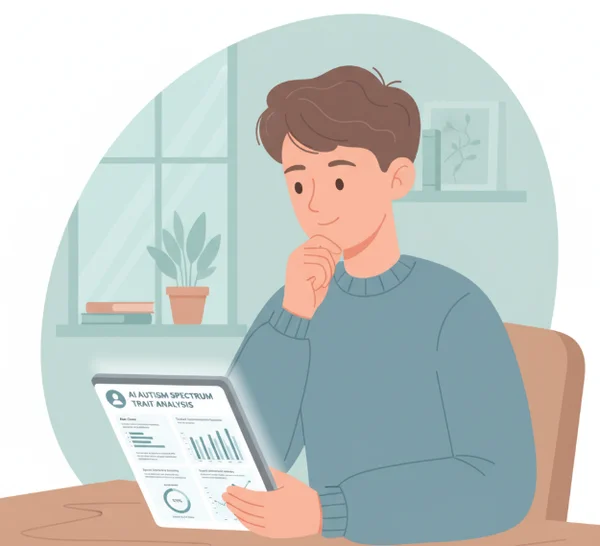
How Your ASD Test Report is Generated
The transition from answering questions to receiving a deep analysis involves a blend of established science and modern technology. Our goal is to make the process of an online test feel personal and accurate, rather than just a series of data points.
The Scientific Framework Behind AI Analysis
The AI does not work in a vacuum. It is built upon established ASD assessment frameworks that have been used by specialists for decades. These include principles found in tools like the Autism Spectrum Quotient (AQ) and the Modified Checklist for Autism in Toddlers (MCHAT).
When you answer questions about social communication, sensory sensitivities, and behavioral patterns, the AI compares these responses against validated screening benchmarks. It identifies patterns that might be hard for a person to see on their own. For example, it might notice a specific correlation between your sensory processing and your social energy levels. This scientific foundation ensures that the insights you receive are grounded in recognized developmental principles.
Your Personalized Data Journey
A standard score only tells part of the story. To give you a truly personalized report, our system allows you to provide additional background information. This might include your age, your specific challenges in the workplace, or your observations as a parent. The AI integrates this context to refine its analysis.
We take your privacy very seriously. All information processed for your report undergoes strict anonymization and data protection protocols. Your unique profile is then used to generate tailored recommendations that feel relevant to your actual life. Instead of generic advice, the AI looks at your specific "data journey" to suggest steps that fit your current environment and needs.

Decoding Your Online ASD Test Results
Once you receive your report, it can feel overwhelming to see so much information at once. Breaking it down section by section helps you digest the information at your own pace. Using our screening tool is just the beginning. It opens up a larger conversation with yourself or your loved ones about your unique experiences.
Understanding Your ASD Trait Profile
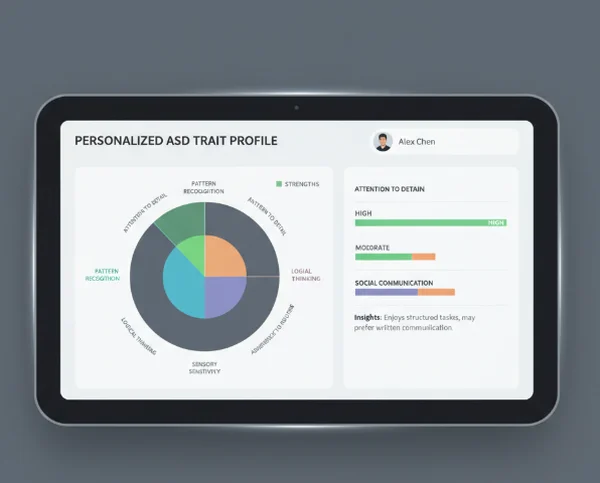
The first major part of your report is the ASD Trait Profile. This section visualizes your specific characteristics across different domains. Rather than saying you "pass" or "fail," it highlights your strength and challenge indicators.
For instance, you might see that you have high scores in "Attention to Detail" but face significant challenges in "Social Communication." By looking at these patterns, you can see real examples of how your traits manifest. A profile with high sensory sensitivity and high detail-orientation is common among many autistic individuals and can often be a "superpower" in certain professional fields like coding or design.
The Daily Impact Analysis
The Daily Impact Analysis is where the report gets practical. It answers the question: "How do these traits affect my life on Tuesday morning or Friday night?" This section translates abstract scores into everyday situations.
Common scenarios include how social exhaustion (often called "autistic burnout") might hit after a long day of meetings, or how certain sounds might make it difficult to focus in a busy office. On the flip side, it also highlights potential strengths. Many people discover that their profile explains their deep focus and passion for specific personal interests, which can lead to high levels of expertise and personal satisfaction.
Your Personalized Action Plan
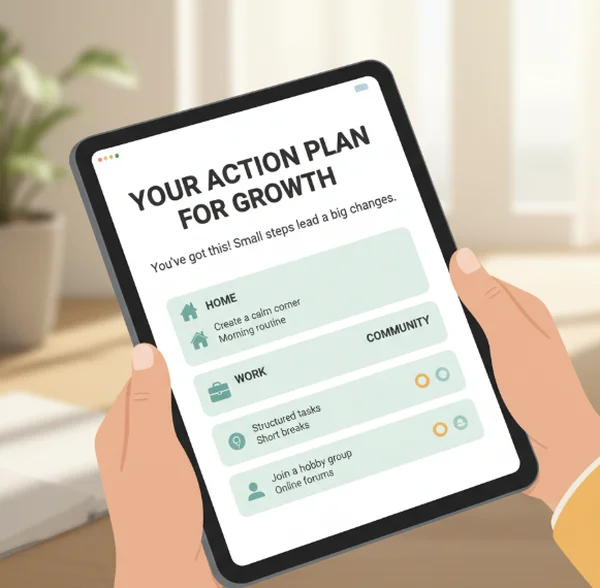
After you receive your results, you might wonder: "Now what? How can I use this information to make my life better?" Your report includes a Personalized Action Plan designed to help you prioritize recommendations. This isn't a medical prescription, but a guide for personal growth and self-understanding.
The plan might suggest creating a "sensory-friendly" corner in your home or trying specific communication tools with your partner. It encourages you to set achievable goals, such as learning more about "masking" or finding a community of people with similar traits. These resources are tailored to your profile, ensuring the next steps feel manageable rather than daunting.
Maximizing Value from Your ASD Screening Report
Understanding the theory is one thing, but seeing how others have used their receive insights can be truly inspiring. Real-world applications help bridge the gap between a digital report and a better life.
From Test Results to Personal Breakthroughs
We have seen many users find clarity through their personalized reports. Here are three anonymized examples of how these insights lead to breakthroughs:
- Case Study 1: Alex, a software engineer, used his report to realize that his "difficulty" with coworkers was actually a difference in communication style. He shared his trait profile with his manager, and they adjusted his schedule to allow for more quiet, focused work time.
- Case Study 2: Sarah always felt overwhelmed in grocery stores but didn't know why. Her report highlighted high sensory sensitivity. She started wearing noise-canceling headphones and shopping during quiet hours, which significantly reduced her daily anxiety.
- Case Study 3: Jamie, a college student, leveraged her profile to understand why she felt so tired after social events. By acknowledging her need for "recovery time" as part of her action plan, she stopped feeling guilty about needing weekends to herself.
Best Practices for Your Analysis
To get the most out of your analysis, we recommend reviewing it more than once. The first time, you might focus on the scores. The second time, you might look more closely at the action plan.
It can also be helpful to share specific sections with trusted individuals. You don't have to share the whole report, but showing a friend the "Daily Impact Analysis" can help them understand your needs better. Think of your report as a living document—a tool to help you advocate for yourself in the real world.
Understanding AI Limitations: Realistic Expectations for Your ASD Test
While AI is a powerful tool, it is important to use it responsibly. Transparency builds trust, and we want you to understand exactly what the technology can and cannot do.
What the AI Cannot Do
The most important thing to remember is the difference between screening insights and a clinical diagnosis. An AI analysis report is a sophisticated screening tool, but it is not a medical diagnosis. Only a qualified healthcare professional, such as a psychologist or psychiatrist, can provide a formal ASD diagnosis.
AI cannot assess the subtle nuances that a human professional might catch during a face-to-face interview. It cannot observe your body language or hear the tone of your voice in real-time. Therefore, you should always treat the report as a "preliminary guide" rather than a final verdict. If your results suggest high support needs, we strongly encourage you to seek a professional evaluation.
Interpreting Results with Context
No two people are identical, and no two reports are the same. Your results are influenced by your current life circumstances, stress levels, and other co-occurring conditions like ADHD or anxiety. This is why we call it a "spectrum."
When you read your results, consider the context of your life. If you are going through a very stressful period, your sensory sensitivities might appear higher than usual. The AI provides a snapshot based on the data you provide. If you feel your results don't quite "fit," it might be a sign to consider additional assessment or to discuss the findings with a therapist who understands neurodiversity.
Putting it all together: Turning Insights Into Action
Putting it all together, your AI report serves as your personalized roadmap to deeper self-understanding. It combines scientific principles with a personalized analysis of your unique experiences. By moving beyond a simple score, you gain a roadmap that highlights your strengths, explains your challenges, and offers a path forward.
Think of your report as the first chapter in your understanding story, not the final word. Whether you're a parent seeking answers or an adult on a journey of self-discovery, our shared goal is the same. We want to make life richer and exploration easier for everyone. Knowledge is the foundation of self-advocacy and growth.
Ready to discover what insights your own AI analysis report might hold? You can start your test today and unlock the power of personalized understanding about how you experience the world.
The Takeaway
How accurate is the AI analysis compared to professional assessment?
The AI analysis is designed as a high-quality screening tool. It is very effective at identifying traits and patterns associated with the autism spectrum. However, it is not a replacement for a professional clinical assessment. A professional assessment involves hours of observation and history-taking that a digital personalized report cannot fully replicate. Use the AI report as a "first step" to help you decide if you need professional consultation.
Can I retake the test to get a different AI report?
Yes, you can retake the test. Many users find it helpful to retake the screening after they have had time to reflect on their traits. Sometimes, as we learn more about autism, we recognize behaviors in ourselves that we didn't notice before. Providing more detailed or updated background information will allow the AI to generate a more refined and current analysis of your situation.
Is my personal data used to train the AI?
We prioritize your privacy above all else. Your personal data is used specifically to generate your individual report and is protected by strict security measures. We do not sell your personal identifying information to third parties. Any data used to improve our systems is anonymized, meaning it cannot be traced back to you.
How long does it take to generate my AI report?
Generating a standard summary is almost instant. However, the comprehensive AI personalized report takes a few moments to process because the system must analyze your specific background data against scientific frameworks. Usually, you will receive your deep insights within a few minutes of completing the questionnaire and providing your additional context.
Can I share my AI report with my healthcare provider?
Absolutely. In fact, we encourage it. Although not a diagnostic tool, your report offers valuable organized information for healthcare providers. It helps you articulate your concerns clearly and gives your provider a solid foundation for a formal evaluation. Sharing the report can save time and help you get to the heart of your challenges more quickly.