Teacher's Guide: Recognizing ASD Traits & Recommending an ASD Test for Screening
Educators are on the front lines of child development, uniquely positioned to observe the subtle nuances of how students interact, learn, and experience the world. You witness their breakthroughs and their challenges daily. Sometimes, these challenges present as consistent patterns that might suggest underlying neurodevelopmental differences, such as Autism Spectrum Disorder (ASD). Recognizing these traits is the first step, but the next—communicating with parents—can be daunting. The goal isn't to diagnose but to empower families with the right resources for initial exploration. That's where a preliminary asd test can serve as a compassionate and informative starting point. But how do you responsibly guide a family toward this first step?
This guide is designed for you—the dedicated teacher, counselor, or school professional. We will walk through how to recognize potential ASD traits in a classroom setting, document your observations objectively, and approach parents with supportive, actionable advice. By the end, you will feel more confident in recommending a user-friendly, non-diagnostic tool like our online screening platform, helping families begin their journey of understanding. You can suggest they get initial insights to better understand their child.

Understanding ASD Traits in the Classroom Environment
Autism presents as a broad spectrum, with characteristics varying widely from student to student. Nevertheless, many of these traits surface clearly within a structured, social environment like the classroom. Grasping these core areas can significantly enhance your observations.
Common Social Communication Differences in Children
One of the most noticeable areas involves social communication. A student on the autism spectrum may find navigating the unwritten social rules of the classroom challenging. You might observe a child who has difficulty initiating or maintaining conversations with peers, struggles to understand non-verbal cues like facial expressions or sarcasm, or prefers to play alone rather than in groups. They may also have a very literal interpretation of language, which can lead to misunderstandings during lessons or social interactions.
Recognizing Repetitive Behaviors and Restricted Interests
Repetitive behaviors and highly focused interests are hallmark traits of ASD. This can manifest as repetitive physical movements, often called "stimming," such as hand-flapping, rocking, or spinning. You might also notice a student who insists on strict adherence to routines and becomes distressed when the class schedule changes unexpectedly. Furthermore, they may develop an intense, deep interest in a specific topic—like dinosaurs, train schedules, or a particular video game—and talk about it extensively, often without noticing if others are engaged.
Sensory Sensitivities & Executive Function Challenges
The classroom can be a source of sensory overload for some students with ASD. Sensory sensitivities can involve hypersensitivity (over-responsiveness) or hyposensitivity (under-responsiveness) to sounds, lights, textures, or smells. A student might be distressed by the hum of fluorescent lights, the chatter of classmates, or the feel of a certain art supply. Separately, challenges with executive function—the mental skills that include working memory, flexible thinking, and self-control—can make it difficult for a student to organize their desk, manage multi-step assignments, or transition between activities.

Identifying Signs of Autism in Students: What to Observe
Your role is not to diagnose but to observe and collect information. Shifting your focus from "Is this student autistic?" to "What specific behaviors am I seeing?" creates a more objective and helpful foundation for any future conversations with parents or specialists.
Objective Observation: Documenting Specific Behaviors
Keep a log of specific, non-judgmental observations. Instead of writing "Sam was disruptive," document "During silent reading, Sam rocked in his chair and hummed for 10 minutes." Instead of "Maria is antisocial," note "During group work, Maria turned her body away from her peers and did not make eye contact or contribute to the conversation." This objective observation provides concrete examples that are invaluable when discussing concerns. A preliminary ASD test can help contextualize these observations for parents.

When to Be Concerned: Developmental Milestones and Red Flags
While every child develops at their own pace, there are general developmental milestones to keep in mind. Be mindful of significant delays or deviations, especially in social and communication skills. For example, a preschooler who doesn’t respond to their name, doesn't point at objects to show interest, or avoids eye contact might warrant closer observation. In older children, a persistent difficulty in making or keeping friends or understanding others' perspectives can also be a significant indicator.
Distinguishing ASD from Other Classroom Challenges
Many behaviors associated with ASD can overlap with other conditions like ADHD, anxiety, or learning disabilities. For instance, difficulty focusing could be related to executive function challenges in ASD or an attention issue in ADHD. The key is to look at the overall pattern of behavior. Are the challenges primarily social and communicative? Are repetitive behaviors present? Your detailed observations will help specialists make an accurate assessment later on.
Approaching Parents: How to Discuss Autism Concerns
This is often the most delicate step. A supportive, collaborative, and non-alarming approach is crucial. You are a partner in the child’s education, and this conversation should reflect that partnership.
Preparing for a Sensitive Conversation: Best Practices
Schedule a private meeting with the parents. Begin the conversation by highlighting the child's strengths and positive attributes. This establishes a foundation of care and trust. Frame your concerns using your objective notes, focusing on what you've observed in the classroom and how it impacts their learning or social experience. Use "I've noticed..." statements rather than "Your child always..." to keep the tone collaborative.
Framing Observations in a Supportive, Non-Diagnostic Way
It is critical to emphasize that you are not making a diagnosis. Use careful, supportive conversation to frame your observations. You could say, "I've noticed that Leo seems to have a hard time with transitions between activities, and I wanted to partner with you to see if we can find ways to make his day smoother." Avoid using labels like "autism" or "autistic." Instead, focus on the behaviors and the shared goal of supporting the child.
Guiding Parents Towards Initial Screening Resources
After sharing your observations, parents will likely ask, "What should we do?" This is the moment to empower them with resources. You can suggest they start with an accessible, low-pressure first step. Recommend they explore an online screening tool as a way to gather more information privately and at their own pace. Frame it as a tool for understanding, not a definitive answer. You might say, "Some parents find it helpful to start with an online preliminary screening to organize their thoughts before speaking with a doctor. It can provide some initial insights."
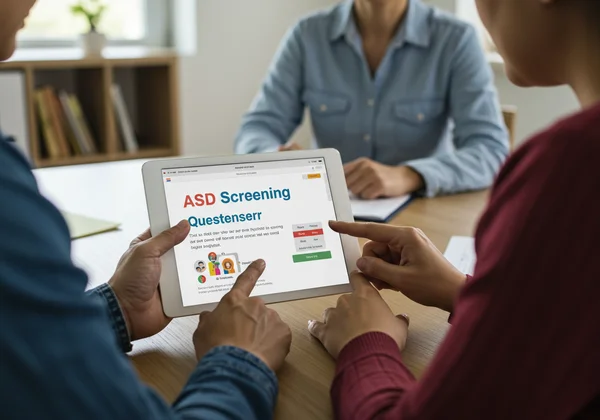
Leveraging Online Tools: Autism Screening for Schools & Families
Online screeners have become valuable resources for families beginning their journey. They are accessible, private, and can demystify the initial stages of exploration, making them a key resource for autism screening for schools to recommend.
What an Online ASD Screening Provides (and Doesn't)
It is essential to clarify what an online screening is. It is a preliminary screening tool designed to identify traits commonly associated with ASD. It is not a medical diagnosis. The results provide a summary that can indicate whether a formal evaluation with a healthcare professional, like a developmental pediatrician or a child psychologist, would be a logical next step.
Why This Platform is a Responsible First Step for Parents
When recommending a tool, it's important to guide parents to a reliable source. This platform is designed to be a responsible first step. It clearly states its non-diagnostic purpose, prioritizes user privacy, and provides results that are easy to understand. For parents who want to go deeper, it offers a unique AI-powered report that can help translate the screening results into potential strengths, challenges, and actionable next steps. Suggesting this platform shows that you are providing a helpful, modern, and non-intimidating resource. Parents can explore the test without pressure.
Partnering with Families in Their Next Steps
Your support doesn't end after the conversation. Reassure parents that you are their partner, regardless of the screening results or any future diagnosis. The goal is always to create the best possible learning environment for the student. Whether it involves simple classroom accommodations, collaborating on an Individualized Education Program (IEP), or simply having a better understanding of the child's needs, your role remains vital.
Empowering Educators to Support Every Student's Journey
As an educator, your observations are a powerful tool for early identification and support. By learning to recognize potential ASD traits, documenting them objectively, and communicating with parents compassionately, you make a profound difference. You are a vital connector, bridging the gap between classroom challenges and a family's journey toward empowerment. Encourage parents to take that gentle first step. Guiding them to a resource like the free asd test online can provide the clarity and confidence they need to move forward in supporting their child.
Frequently Asked Questions for Educators on ASD Screening
How is an online ASD screening different from a medical diagnosis?
An online screening is a preliminary, informational tool that uses a questionnaire to identify traits associated with ASD. A medical diagnosis is a comprehensive evaluation conducted by a qualified healthcare professional, involving direct observation, developmental history, and standardized assessments. The screening is a first step; the diagnosis is a definitive conclusion.
What kind of questions are typically asked in a preliminary ASD screening?
Questions in a preliminary ASD screening are typically based on observable behaviors related to social communication, interaction, repetitive behaviors, and sensory sensitivities. Parents answer based on their observations of their child's daily life, which mirrors the kinds of notes you might take in the classroom.
Are online ASD screening tests reliable for initial insights?
Yes, when used as intended. A quality online screener, like our dedicated online tool, is based on established principles from scientifically validated tools. While not a substitute for a professional evaluation, it is a reliable way to gain initial insights and determine if a formal assessment is warranted.
What should parents do after their child takes an online ASD screening?
After receiving the results from an online screening, parents should use them as a conversation starter with a qualified professional, such as their child's pediatrician, a psychologist, or a developmental specialist. The results can help organize their concerns and provide a clear starting point for a professional consultation. They can begin this process by visiting the asd test for child page.
What are some early indicators of ASD that I might observe in the classroom?
Some early indicators you might notice include a child not responding to their name, difficulty with pretend play, avoiding eye contact, having delayed speech or language skills, getting upset by minor changes in routine, or showing an intense preoccupation with specific objects or topics.