Is Autism a Psychiatric Disorder: What the Labels Mean
Is autism a psychiatric disorder? If you have seen autism described as a mental illness in one source and a neurological condition in another, the terms may seem contradictory. Autism spectrum disorder (ASD) is classified as a neurodevelopmental disorder in the DSM-5-TR, a manual used by mental health professionals. That classification does not make autism identical to depression or anxiety, although those conditions can occur alongside it.
This guide explains the labels, what they do and do not mean, and how to interpret overlapping experiences. It also offers a short checklist and practical next steps. If the subject feels personally relevant, an online ASD screening questionnaire can support reflection, not provide a formal clinical assessment.
What Does Psychiatric Disorder Mean for Autism?
Autism belongs to the neurodevelopmental disorders category. However, the phrase psychiatric disorder can mean different things depending on the context.
Psychiatry is a medical specialty that addresses mental health and conditions involving thoughts, emotions, behavior, and development. Its diagnostic reference systems include several categories, including neurodevelopmental disorders. In that broad classification context, autism falls within the scope of psychiatry.
In everyday conversation, however, mental illness often refers to conditions such as depression or anxiety. Those conditions are not interchangeable with autism.
Three terms can help you keep the distinction clear:
- Psychiatric classification: A professional system that organizes several categories of conditions.
- Neurodevelopmental disorder: A category involving developmental differences that typically become apparent early in life.
- Mental illness: A broad phrase whose meaning depends on context, often used for conditions affecting mood, thoughts, or emotional well-being.
For example, autism and depression may both appear in psychiatric references. That does not mean they have the same developmental pattern or support needs. The useful question is which classification applies and what it tells you.
Why Is Autism Included in the DSM-5-TR?
The Diagnostic and Statistical Manual of Mental Disorders, Fifth Edition, Text Revision (DSM-5-TR), is a professional reference for classifying mental and neurodevelopmental conditions. It places autism spectrum disorder under Neurodevelopmental Disorders.
Autism's Place Among Neurodevelopmental Disorders
Autism involves developmental differences related to social communication and interaction, alongside patterns of interests, behavior, or sensory experiences. These characteristics generally begin during early development, even if you only recognize them later.
A classification describes a pattern, not a conclusion based on one behavior. For instance, finding conversation tiring does not, by itself, establish autism. Professional evaluation considers developmental history and a broader set of experiences.
What DSM Classification Does and Does Not Mean
The word disorder is part of the manual's formal terminology. It does not mean that everyone in a category has identical abilities, experiences, or needs.
Likewise, appearing in a manual used by psychiatrists does not mean autism arises from emotional distress. It also does not mean psychiatric medication is necessary for every autistic person.
Another international system, the ICD-11, also places autism among neurodevelopmental disorders. The key point is consistent: a classification explains how professionals organize a condition; it does not describe an entire person.
How Is Autism Different From Common Mental Health Conditions?
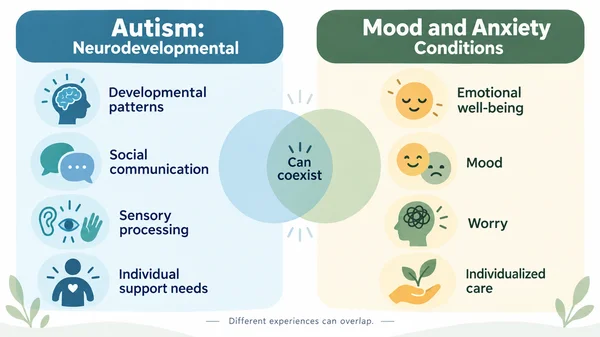
Autism and conditions such as anxiety or depression may shape similar everyday situations, but they represent different diagnostic concepts. Autism involves neurodevelopmental differences, while mood and anxiety conditions involve their own patterns of symptoms and experiences.
Neurodevelopmental Differences and Mental Health Conditions
| Aspect | Autism | Common mood or anxiety conditions |
|---|---|---|
| Classification | Neurodevelopmental disorder | Mood, anxiety, or other relevant categories |
| Developmental context | Characteristics generally emerge early in development | Timing varies with the condition and individual |
| Possible experiences | Differences in communication, sensory processing, interests, or routines | Persistent worry, low mood, or changes in emotional well-being |
| Support | Individualized accommodations and supports, depending on needs | Support tailored to the specific concern and person |
This table describes broad patterns, not a way to sort out your experiences on your own. For example, exhaustion after a party might involve sensory overload, anxiety, ordinary fatigue, or a combination.
Where Does Behavioral Health Terminology Fit?
You may also encounter the phrase behavioral health disorder. Behavioral health is an umbrella term often used for services related to mental health and behavior. Autism-related support can be offered through those services, but the service label does not change autism's formal neurodevelopmental classification.
Rather than choosing between labels, ask whether a term describes the condition, the care setting, or a specific support need.
How Do Neurological, Psychological, and Disability Labels Apply to Autism?
Neurological, psychological, medical, and disability-related descriptions are not always competing explanations. They can address different aspects of autism.
Neurological and Psychological Perspectives on Autism
Autism is associated with differences in brain development and how a person processes information. A neurodevelopmental perspective helps explain why communication, sensory experiences, and routines may differ from person to person.
Psychological perspectives examine experiences such as thinking, communication, emotion, and social interaction. Using psychological concepts does not mean autism is caused by personality, parenting, or an emotional problem.
For example, if you need extra time after a demanding conversation, both sensory conditions and social expectations may be relevant. One perspective does not cancel the other.
Developmental Disability and Medical Classification
Autism is also recognized as a developmental disability. Yet the word disability cannot predict anyone's independence, talents, or daily support needs.
One autistic person may manage work and home independently but benefit from quieter surroundings. Another may need ongoing help with communication or daily tasks. These are different support profiles, not contradictions.
Medical classification can guide assessment, while disability frameworks can help address accessibility and accommodations. Neither should reduce you to a label.
Can Autism and Mental Health Conditions Occur Together?
Yes. Autism can coexist with mental health conditions. Being autistic does not automatically mean you have anxiety, depression, or another psychiatric condition. However, separate concerns may deserve separate attention.
Anxiety and Depression Alongside Autism
Imagine preparing for a presentation at work. You might find the situation hard because of unpredictable questions, a noisy room, fear of judgment, or several factors at once. The experience alone cannot identify the cause.
Likewise, persistent low mood or a loss of interest should not automatically be dismissed as part of autism. Those changes may warrant a conversation with a qualified professional, especially if they affect daily life.
The practical distinction is that autism-related support and mental health support may address different needs. Understanding both can lead to a more useful discussion about what helps.
ADHD and Other Co-occurring Conditions
ADHD is another neurodevelopmental condition, and it can coexist with autism. Some experiences, such as difficulty organizing tasks or managing attention, may overlap. Still, the two classifications are not identical.
Other developmental or health concerns may coexist as well. Rather than relying on a single online score to explain everything, consider the full pattern and the specific areas where support would help.
Why Can Autism-Related Experiences Be Misinterpreted?
The same outward behavior can have different explanations. This is why context matters more than a quick label.
Sensory Overload, Social Situations, and Emotional Distress
Consider two hypothetical situations:
- A crowded restaurant: You become quiet because several conversations and bright lights feel overwhelming. Someone else might assume you dislike socializing, although sensory demands may be relevant.
- A difficult conversation: You pause before answering an emotional question. Someone might read that pause as indifference, while you may simply need more processing time.
Neither situation establishes autism or a mental health condition. They show why an observation is only the beginning of understanding.

Why Personal Context and Developmental History Matter
Use this context checklist when you notice an experience you want to explore:
- What happened just before it?
- Did noise, lighting, uncertainty, or social expectations play a role?
- Has a similar pattern been present since childhood, or is it relatively new?
- Does it occur in several settings or only one?
- What adjustments or support seem helpful?
For example, you might replace "I cannot handle people" with a specific description: "I lose track of conversations when several people speak at once."
A clearer observation gives you something useful to reflect on or discuss. It still does not determine a clinical classification.
How Can You Explore Autism-Related Questions Safely?
You do not have to settle a question about autism immediately. Use these steps to distinguish observations from assumptions.
Notice Patterns Without Rushing to a Label
Try these three practical steps:
- Write down recurring experiences. Focus on communication, sensory demands, routines, or changes in expectations.
- Add the setting. Record what was happening, what felt difficult, and whether something made the experience easier.
- Turn observations into questions. For example: "Does this happen across different settings?" or "What support could make this situation manageable?"
Keep your notes descriptive. A pattern of experiences can inform a conversation without providing a diagnosis on its own.
What a Preliminary ASD Screening Questionnaire Can and Cannot Offer
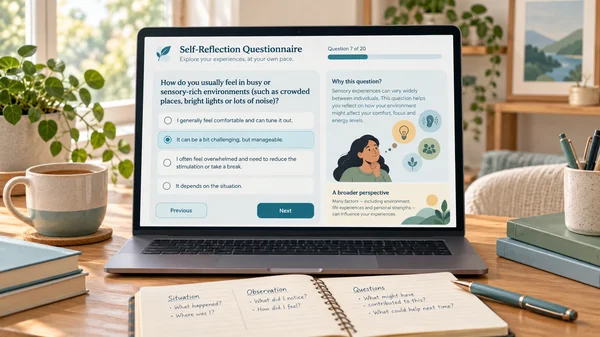
ASDTest.org provides a 20-item preliminary questionnaire and a basic results summary. It also offers an optional AI Personalized Report for additional educational reflection.
If you would like a structured starting point, an ASD screening questionnaire may help organize observations and questions. It is not a substitute for professional assessment.
Keep these limits in mind:
- A score cannot independently establish an ASD diagnosis.
- A questionnaire cannot reliably separate every overlapping explanation.
- An AI-generated report cannot replace individual clinical judgment.
- A result does not define your abilities or future.
The site is intended for ages 13 and older. If you are concerned about a younger child's development, seek age-appropriate guidance from a qualified professional.
When Professional Guidance May Be Helpful
Consider asking for help if your questions remain unresolved or an experience significantly affects work, school, relationships, or daily life. Persistent low mood, anxiety, or changes in functioning also deserve attention.
A professional familiar with autism can review developmental history and your current concerns. Bring observations and questions rather than trying to prove a particular label.
Understanding Autism Beyond a Psychiatric Label
So, is autism a psychiatric disorder? In formal classification systems used within psychiatry, autism appears in the neurodevelopmental disorders category. That does not make it interchangeable with depression, anxiety, or other conditions, even though they may coexist.
Understanding the distinction can help you ask more precise questions. You can notice patterns, consider what accommodations help, and decide whether you want further guidance.
If you prefer a gentle starting point, an ASD test for self-reflection can be one optional educational resource. Its results and optional AI insights cannot replace a professional evaluation.
Your experiences matter beyond any label. The aim is clearer understanding and support that fits your circumstances.
Frequently Asked Questions
Can autistic people have good mental health?
Yes. Autism does not automatically mean poor mental health. Autistic individuals can experience fulfilling relationships and emotional well-being. As with anyone else, well-being can change, and supportive environments or appropriate care may help.
Does every autistic person need psychiatric care?
No. Needs vary. Some autistic people may benefit from psychiatric care for a separate mental health concern. Others may primarily need accommodations, communication support, or community resources. Individual circumstances should guide the next step.
Is autism considered a medical condition?
Autism is a recognized neurodevelopmental condition included in formal diagnostic systems. Medical recognition can guide assessment and support, but it does not mean every autistic experience or characteristic should be treated as an illness.
Is autism a behavioral health disorder?
Behavioral health is a broad term for care and services. Autism-related services may fall within that area, but autism's specific classification in the DSM-5-TR is neurodevelopmental. The type of service does not redefine the condition.
What Can Online ASD Screening Tell You About Overlapping Experiences?
An online questionnaire may help organize observations about communication, sensory experiences, or routines. However, it cannot determine whether autism, anxiety, another condition, or several factors explain them. A qualified professional can consider developmental history and individual needs.