Autism Genetic Factors: How Genes, Family History, and Environment Fit Together
If you are searching for "autism genetic," you may be trying to answer a personal question: did this come from one side of the family, could it affect another child, or does genetic testing explain everything? The honest answer is more layered. Autism is a neurodevelopmental condition with a strong genetic component, but it is not usually caused by one single "autism gene." Many genetic differences, inherited traits, new genetic changes, early brain development, and environmental factors can all shape autism-related traits. For families and adults who are still sorting through patterns, a calm ASD screening starting point can support reflection while keeping the next step educational rather than clinical.

Is Autism Genetic or Neurological?
Autism is neurological in the sense that it involves early brain development, communication, sensory processing, social interaction, behavior patterns, and support needs. It is also genetic in the sense that inherited and new DNA differences can influence how the brain develops. These two descriptions are not opposites. A genetic influence can affect neurological development, and neurological differences can appear in many different combinations from person to person.
That is why broad statements such as "autism is genetic" or "autism is environmental" can be too simple. Current research points to a complex model: genetics often contributes substantially to autism likelihood, while environmental and developmental factors may affect timing, expression, co-occurring conditions, and support needs. A child may have autistic relatives, subtle family traits, or no obvious family history at all. An adult may recognize lifelong patterns only after learning more about sensory needs, social fatigue, masking, or intense interests.
The practical takeaway is this: genetics can help explain risk and biology, but it does not reduce an autistic person to a DNA result. Autism is still understood through development, lived experience, behavior, strengths, challenges, and the kind of support that improves daily life.
Why There Is No Single Autism Gene
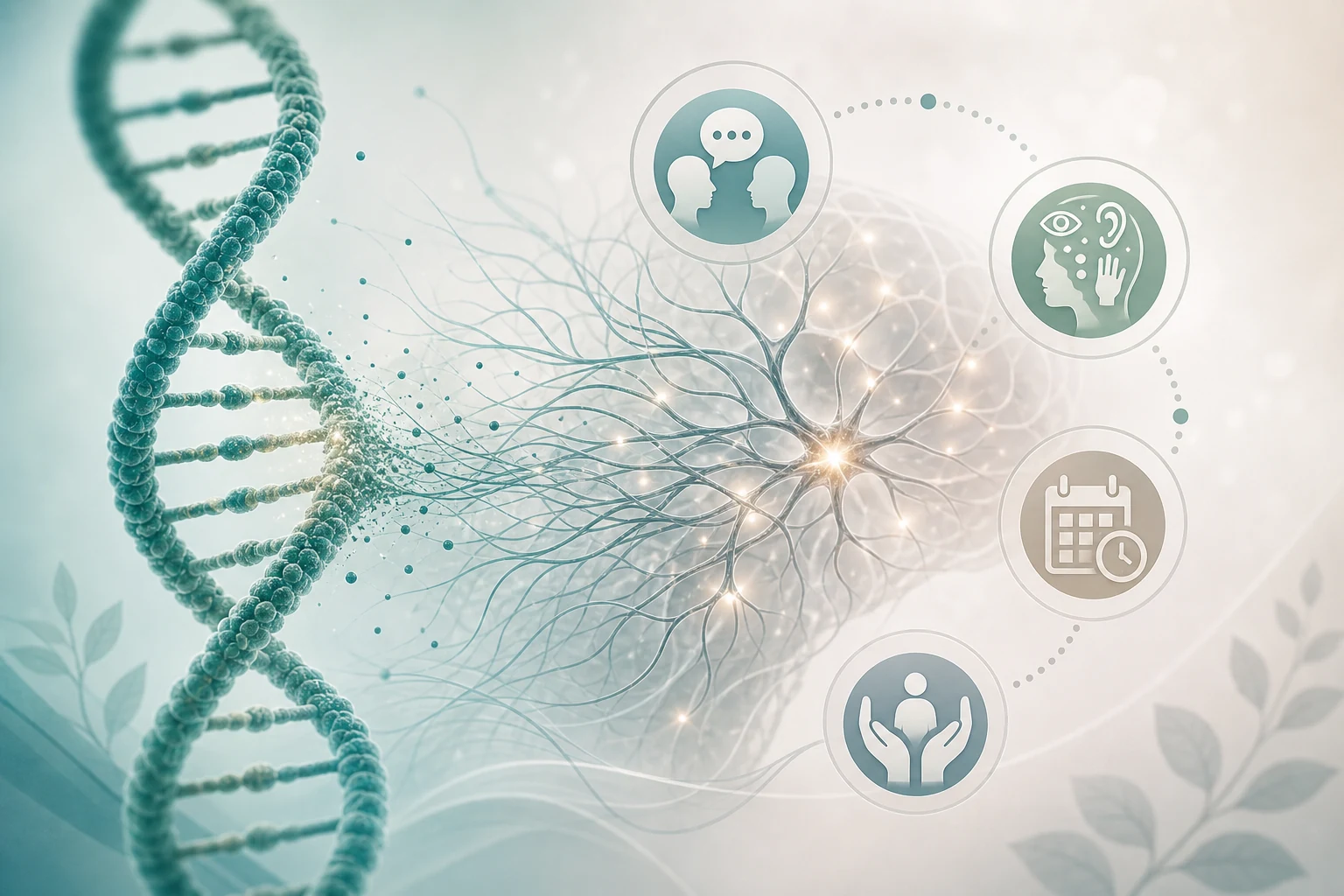
Many people ask who carries "the autism gene." The phrase is common, but it can be misleading. For most people, autism is not traced to one gene passed neatly from one parent to a child. Instead, researchers describe autism as genetically heterogeneous, meaning many different genetic pathways can be involved.
Some autism genetic factors are polygenic. That means many common DNA differences each contribute a small amount to overall likelihood. A parent may carry some of these variations without being autistic, or may have mild traits that were never formally evaluated. Other genetic factors are rare variants with larger effects. Some are inherited; others are new changes that appear in an egg, sperm, or early embryo.
There are also known genetic conditions that can be associated with autism traits, such as fragile X syndrome or certain copy number variations, where a section of DNA is deleted or duplicated. These are important, but they account for only part of the autism picture. Most autistic people do not have one simple genetic result that explains every trait.
This complexity also helps explain why two autistic people can be very different. One person may need substantial communication support. Another may speak fluently but struggle with sensory overload, executive function, or social recovery time. Genetics may influence both, but the visible profile can vary widely.
Autism Genetic Inheritance From Mother or Father
"Is autism genetic from mother or father?" is one of the most searched questions because families naturally look for a clear source. The best answer is that autism-related genetic influences can come from either parent, both parents, or from new genetic changes that were not present in either parent's body cells.
Inherited variants can be passed through maternal or paternal lines. Some parents may show subtle autism-like traits, such as sensory sensitivity, preference for routine, social fatigue, focused interests, or pragmatic language differences. Others may not notice any traits at all. That does not mean they did anything wrong, and it does not mean one parent is responsible.
Research also discusses new, or de novo, genetic changes. These are not inherited in the usual family-history sense. They can arise during the creation of reproductive cells or very early development. Some studies have examined paternal age because sperm cells divide throughout life, which can increase the chance of new genetic changes with age. That finding does not mean fathers "cause" autism. It simply points to one biological pathway among many.
Another idea in genetics research is the female protective effect. In simplified terms, some researchers propose that females may, on average, need a higher genetic load before autism traits become visible enough for formal identification. This may help explain why autism has historically been recognized more often in males, and why autistic girls and women may be missed or misunderstood. It is still an area of active research, not a simple rule.
Autism Genetic and Environmental Factors Work Together
Genetic likelihood is only part of the picture. Environmental factors do not mean parenting style, personality, or blame. In autism research, environmental usually refers to non-genetic influences around pregnancy, birth, early development, health, and broader living conditions.
Examples studied in the research literature include advanced parental age, very early birth, very low birth weight, some prenatal exposures, maternal immune or metabolic conditions, and birth complications that affect oxygen. These are risk associations, not one-to-one explanations. Many children with these risk factors are not autistic, and many autistic people have none of them.
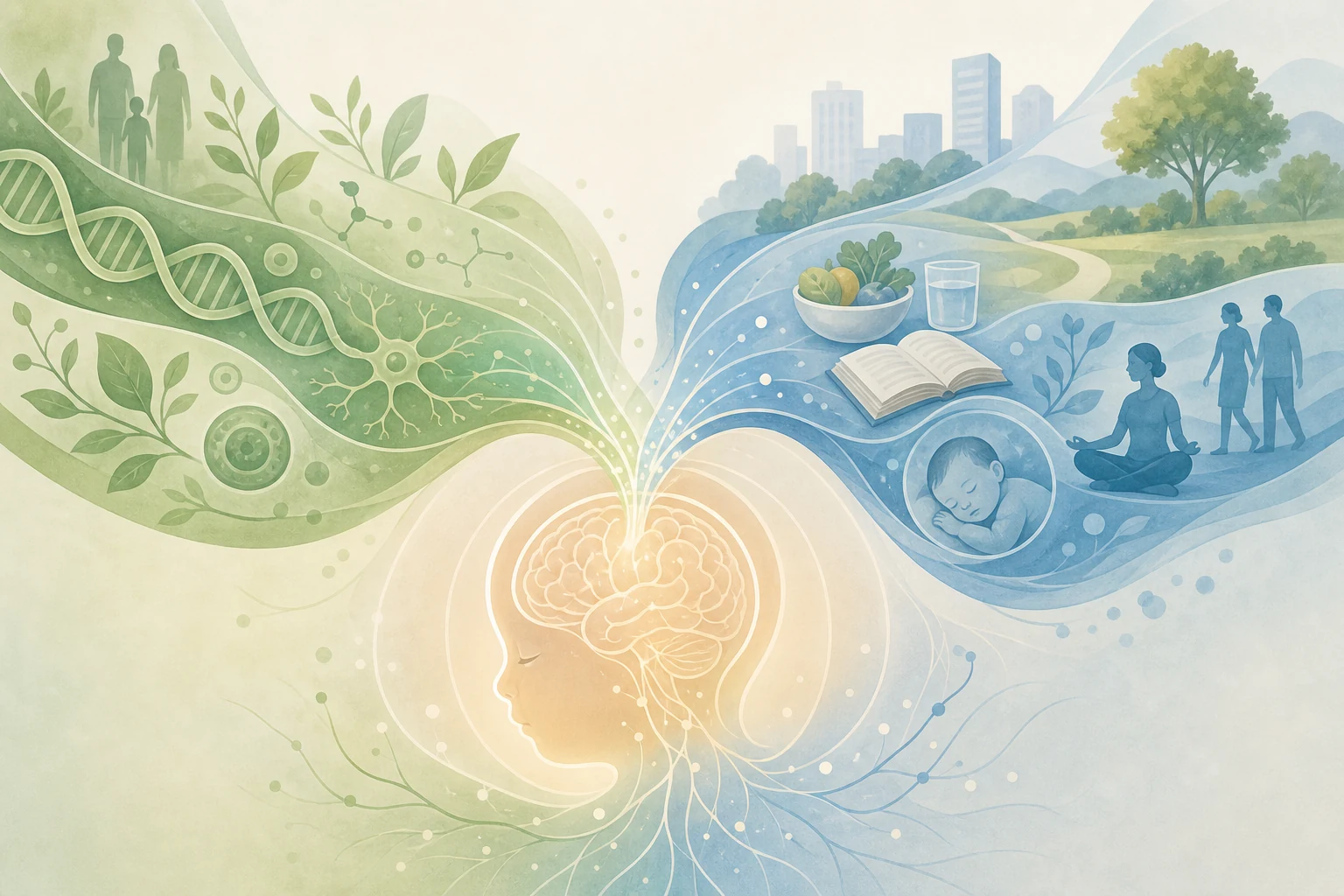
It can help to think of autism development as a landscape rather than a switch. Genes may shape the terrain. Environmental and developmental factors may influence how that terrain is expressed. The final profile is still individual. Family history, early milestones, language development, sensory patterns, learning needs, co-occurring ADHD or anxiety, and daily functioning all matter when understanding support needs.
This is also why responsible autism content avoids certainty. Genetic and environmental risk factors can inform research and conversations with professionals, but they cannot predict a person's identity, abilities, or future with precision.
What Autism Genetic Testing Can and Cannot Tell You
Genetic testing for autism is a separate topic from online screening. A genetic test looks for DNA changes that may be associated with autism or with co-occurring medical concerns. It may include chromosomal microarray, fragile X testing, targeted gene testing, or broader sequencing depending on age, health history, family history, and a clinician's judgment.
The important limitation is that genetic testing does not function like a simple autism yes-or-no answer. A result may identify a known genetic syndrome, a copy number variation, a variant with uncertain meaning, or no clear finding. A negative result does not rule out autism traits. A positive result does not describe the full person, their sensory experience, communication style, strengths, or support needs.
Genetic testing may be worth discussing with a pediatrician, genetic counselor, developmental specialist, or other qualified professional when a child has autism traits, developmental delays, intellectual disability, seizures, unusual physical findings, or a strong family history. Adults may also ask about genetics when family planning, understanding personal history, or exploring co-occurring conditions.
An online resource is different. A private autism trait screener may help someone organize observations and decide what to discuss next, but it should be treated as a reflection tool, not a replacement for professional evaluation or genetic counseling.

How Families Can Think About Risk Without Blame
Autism tends to run in families, so it is understandable to wonder about recurrence risk. If one child is autistic, the chance that a sibling will also be autistic is higher than in the general population. The exact likelihood depends on family history, sex, genetic findings, and other factors. This is a conversation for a qualified professional who can consider the whole family context.
For parents, the emotional side matters too. Questions about inheritance can easily turn into guilt. A more useful frame is: what patterns have we noticed, what support does this person need, and what information would help us make thoughtful decisions? Genetics can provide context, but it should not become a courtroom.
Adults exploring their own traits may also find family patterns helpful. A parent, sibling, grandparent, or cousin may have similar sensory preferences, communication patterns, routines, or social recovery needs. These observations are not proof, but they can help someone build a clearer developmental history before speaking with a professional.
If conversations become stressful, keep them practical. Write down examples from daily life: sensory overload, transitions, repetitive movements, focused interests, social confusion, burnout after masking, or difficulty with unexpected change. Concrete examples are usually more useful than trying to assign genetic responsibility.
Autism Genetic Markers and the Future of Research
Autism genetic research is moving quickly, but translation into everyday clinical use remains challenging. Scientists continue to study common variants, rare variants, copy number variations, inherited patterns, de novo changes, and how different genetic pathways may relate to different developmental profiles.
The phrase "autism genetic markers" can sound as if there is a simple blood test that identifies autism itself. That is not where the field currently stands for most people. Researchers can identify genetic changes associated with increased likelihood, but autism is still understood through developmental history and observed traits. Genetic findings may sometimes guide medical follow-up, family counseling, or research participation, yet they do not replace a holistic understanding of the person.
Future research may improve personalized support by clarifying biological subgroups, co-occurring risks, and developmental trajectories. The opportunity is real: better information could help families and professionals choose supports more thoughtfully. The challenge is equally real: autism is diverse, and genetic data can be misread if presented without context.
Good communication should keep both truths together. Genes matter. Environment matters. Development matters. The person matters most.
A Thoughtful Next Step After Reading About Autism Genetic Factors
If this topic brought up questions about yourself, your child, or your family history, the next step does not have to be dramatic. You might begin by gathering observations, noting family patterns, reading about autism traits across age and sex, and deciding whether to speak with a qualified professional. If there are medical concerns, developmental delays, seizures, intellectual disability, or complex family-planning questions, genetic counseling may be especially relevant.
For everyday reflection, supportive first-step ASD resources can help you organize what you are noticing before a professional conversation. Keep the frame gentle: an autism genetic explanation is not about blame, certainty, or reducing someone to biology. It is one piece of a larger picture that includes sensory needs, communication, identity, relationships, strengths, and practical support.

FAQ
Will my child have autism if the father has it?
Not necessarily. A father's autism traits or genetic background may increase the likelihood that a child has autism traits, but it does not make the outcome certain. Autism-related genetic influences can come from either parent, both parents, or new genetic changes. If you have specific family-planning concerns, a genetic counselor or qualified healthcare professional can discuss your family history in context.
Does autism usually run in families?
Autism often shows family patterns, and siblings or relatives may share autistic traits, ADHD, language differences, sensory sensitivities, or social communication patterns. Still, some autistic people have no obvious family history. Family patterns can be useful clues, but they are not the whole explanation.
Is autism genetic from mother or father?
Autism genetic inheritance is not limited to one parent. Inherited variants may come from the mother, the father, or both. Some genetic changes are new rather than inherited. Research may study different maternal and paternal pathways, but it is not accurate or helpful to assign responsibility to one parent.
Can genetic testing show autism?
Genetic testing can sometimes find a genetic change associated with autism traits or related medical conditions. It cannot fully explain a person's support needs, strengths, sensory experience, or developmental history. A negative genetic result also does not rule out autism traits.
Are autism genetic markers the same as a simple autism test?
No. Genetic markers are DNA findings associated with increased likelihood or related conditions. They are not the same as a complete autism evaluation, and they are not a simple yes-or-no answer for most people. Autism is understood through developmental history, observed traits, and support needs.
What are the three main causes of autism?
It is more accurate to talk about three broad influence areas: genetics, early brain development, and environmental or developmental risk factors. These influences interact in complex ways. They do not point to one universal cause for every autistic person.
Is autism genetic or environmental?
Autism is best understood as both genetic and developmental, with environmental factors sometimes influencing risk or expression. Genetics often plays a major role, but environmental associations and individual development also matter. The balance can differ from person to person.
What does it mean to be high functioning autistic?
"High functioning" is a common phrase, but many autistic people and clinicians find it too vague. It can hide real support needs, especially for people who speak fluently, mask traits, or do well in some settings but struggle in others. More specific language, such as support needs, sensory needs, communication style, and daily-life challenges, is usually more helpful.