Autism Disorders Types: What the Classifications Mean Today
If you search for autism disorders types, you may see several different answers: three support levels, four older labels, five historical categories, or seven related conditions. That can feel confusing if you are trying to understand yourself, your child, or a student without jumping to conclusions. The clearest modern answer is that autism is currently understood as one autism spectrum disorder, with individual differences described by traits, support needs, language profile, learning profile, sensory patterns, and co-occurring conditions. For a private first step, a gentle ASD screening starting point can help you organize observations before deciding whether to seek professional guidance.
The Short Answer: ASD Is One Spectrum, Not Seven Boxes
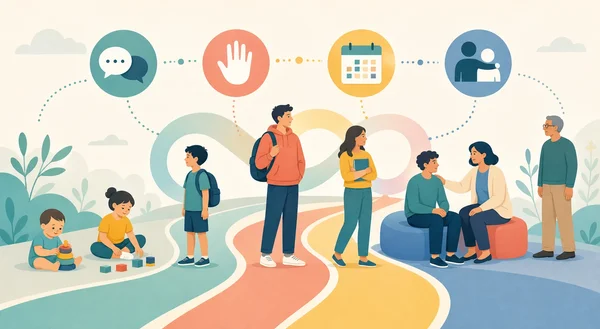
Autism spectrum disorder is a developmental disability and neurodevelopmental condition. It can affect social communication, interaction, behavior, learning, sensory processing, and daily support needs. The word spectrum matters because autistic people do not fit into one narrow profile. One person may speak fluently but find social timing exhausting. Another may use few spoken words and need substantial daily support. Someone else may have strong academic skills, intense interests, sensory sensitivities, and a long history of masking.
In current U.S. clinical language, autism is not usually split into separate official types such as Asperger's, classic autism, or PDD-NOS. Those older labels still appear in articles, family records, school conversations, and online searches, but they are now usually understood under the broader ASD umbrella.
The modern classification focuses less on assigning a person to a type and more on describing what support they need. That includes communication needs, restricted or repetitive behaviors, sensory differences, intellectual or language differences, medical or genetic factors, and other developmental or mental health conditions that may also be present.
Why Do Articles Mention 3, 4, 5, or 7 Types of Autism?
Different numbers come from different systems. They are not always wrong, but they are often talking about different things.

The 3 Main Autism Support Levels
When people ask "what are the 3 main types of autism," they usually mean the three ASD support levels. These levels describe how much support a person may need in social communication and restricted or repetitive behavior patterns:
| Level | Common shorthand | What it means in plain English |
|---|---|---|
| Level 1 | Requires support | The person may manage many daily tasks but still need support with social communication, flexibility, transitions, or sensory demands. |
| Level 2 | Requires substantial support | Differences are more noticeable across settings, and the person may need more consistent help with communication, routines, behavior, or daily participation. |
| Level 3 | Requires very substantial support | The person may need intensive, ongoing support for communication, daily living, safety, regulation, or major transitions. |
These levels are not personality types. They also are not permanent scores. A person's support needs can change by age, environment, health, communication access, sensory load, and whether appropriate supports are available.
The 4 Older Labels People Still Search For
"What are the 4 types of autism?" often refers to older labels that many people still recognize:
- Autistic disorder, sometimes called classic autism
- Asperger's syndrome
- Pervasive developmental disorder not otherwise specified, often shortened to PDD-NOS
- Childhood disintegrative disorder
These terms can still matter historically. A person may have school records, family language, or self-identity connected to one of them. But for current classification, they are generally discussed inside ASD rather than as separate autism disorders types.
The 5 Different Types Lists
"What are the 5 different types of autism" usually adds Rett syndrome to the four older pervasive developmental disorder labels. That is why some lists include autistic disorder, Asperger's syndrome, PDD-NOS, childhood disintegrative disorder, and Rett syndrome.
The important update is that Rett syndrome is now usually treated as a distinct genetic neurodevelopmental condition, not simply a type of autism. It can share some features with autism, including social communication changes or repetitive movements, but it has its own genetic and medical profile.
The 7 Related Conditions Lists
"What are the 7 types of autism" often comes from articles about conditions closely related to autism, not seven official autism types. These lists may include Fragile X syndrome, Rett syndrome, Angelman syndrome, Williams syndrome, Prader-Willi syndrome, Landau-Kleffner syndrome, or other developmental and genetic conditions that can overlap with autistic traits.
That distinction matters. Related conditions can resemble autism in some behaviors, but they may involve different medical histories, genetic findings, health needs, or support plans.
Older Autism Spectrum Disorder Types and What They Mean Now
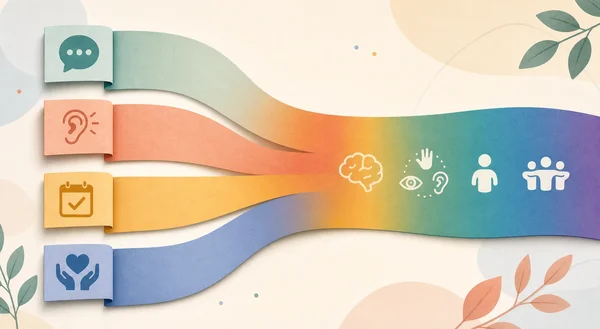
Older labels can be useful when you are reading past records or trying to understand why different generations use different words. They should be handled with care, though, because each label carried assumptions that did not always fit real people.
Autistic Disorder or Classic Autism
Autistic disorder was often used for people with more visible early developmental differences, including social communication challenges, repetitive behaviors, sensory differences, and sometimes language delay. Some people still use "classic autism" informally, especially when describing childhood records.
Today, the more useful question is not whether someone fits a classic picture. It is what supports help that person communicate, participate, regulate sensory input, learn, and live with dignity.
Asperger's Syndrome
Asperger's syndrome was often used for autistic people without early language delay and with average or above-average intellectual ability. Many adults still identify with the term because it was the language available when they first understood themselves.
At the same time, "high functioning autism group" can be misleading. A person may speak well, do well academically, or work successfully while still struggling with burnout, sensory overload, executive function, relationships, anxiety, or daily transitions. Functioning labels can hide real support needs, so many advocates and professionals prefer more specific descriptions.
PDD-NOS
PDD-NOS was a broad older category for people who had meaningful autistic traits but did not neatly fit another label. It could include very different profiles, which is one reason older type systems were hard to use consistently.
If you see PDD-NOS in an older document, it is usually best understood as a historical classification signal. It suggests that developmental, social communication, or behavioral traits were significant enough to be noted, but it does not tell the full story of the person's current needs.
Childhood Disintegrative Disorder
Childhood disintegrative disorder described a rare pattern in which a child developed skills for a period of time and then lost significant abilities across language, social, play, motor, or daily living areas. Because regression can have many possible explanations, this history calls for careful professional evaluation and support planning.
Rett Syndrome
Rett syndrome is often included in older "autism spectrum disorder 5 types" lists, but it is better understood as a separate genetic condition that can overlap with autism-like traits. It commonly involves developmental regression, movement differences, hand stereotypies, and medical considerations. For families, the practical takeaway is simple: overlapping behaviors do not mean two conditions are the same.
What Type of Disorder Is Autism?
Autism spectrum disorder is usually described as a developmental disability and a neurodevelopmental condition. It is not a character flaw, parenting failure, or simple social preference. It reflects differences in how a person's brain develops and how the person communicates, processes information, responds to sensory input, and moves through social environments.
That answer also helps with the question "autism spectrum disorder is what type of disability?" In many educational, service, and public health contexts, ASD is treated as a developmental disability. In real life, disability may be shaped by both a person's traits and the environment around them. A loud classroom, vague instructions, or unpredictable transitions can create more difficulty. Clear routines, communication supports, sensory accommodations, and respectful expectations can reduce barriers.
If you are comparing your own observations with autism spectrum disorder types, a structured ASD trait screener may help you notice patterns such as sensory sensitivity, social fatigue, routine needs, or masking. It should be treated as self-reflection support, not as a final answer.
Common Conditions That Can Overlap With Autism
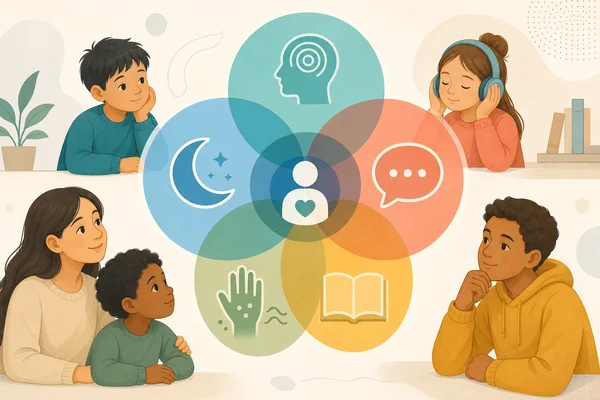
Searches for types of spectrum disorders often mix autism with co-occurring or related conditions. This is understandable because traits can overlap in daily life. ADHD, anxiety, learning differences, sleep problems, gastrointestinal concerns, epilepsy, intellectual disability, language disorders, and sensory processing differences may appear alongside autism for some people.
Overlap does not mean everything should be explained by autism. For example, attention differences may point toward ADHD support strategies. Severe anxiety may need its own care plan. Language differences may require speech-language support. Sleep or gastrointestinal concerns may deserve medical attention. A complete picture can help families, adults, and support teams avoid both overgeneralizing and overlooking important needs.
Here is a simple way to sort the language:
| Phrase you may see | Better way to understand it |
|---|---|
| Types of autism spectrum disorder | Often means older labels, current support levels, or personal trait profiles. |
| Rare types of autism | Usually refers to rare historical labels or related genetic and developmental conditions. |
| Classification types of autism | Best answered by explaining current ASD plus support levels and specifiers. |
| Types of autism spectrum disorder PDF | Usually a request for a quick comparison chart, not a separate official category system. |
How to Use Autism Type Labels Without Losing the Individual
Type labels can be useful as a starting map, but they should never become the whole story. A better question is: what patterns are present, how much support is needed, and what helps this person function with less stress?

Use this quick reflection checklist:
- Which communication patterns show up across more than one setting?
- Are routines, transitions, intense interests, or repetitive movements part of daily life?
- Are sensory inputs such as sound, light, texture, smell, or crowds unusually draining or compelling?
- Does the person seem to mask, copy others, or recover privately after social demands?
- What support already helps: visual schedules, quiet space, direct language, flexible expectations, AAC, occupational therapy, coaching, or school accommodations?
- Are there related concerns, such as sleep, anxiety, ADHD traits, seizures, gastrointestinal issues, learning differences, or language needs?
For ASDTest.org readers, this is where an article about autism disorders types becomes practical. You are not trying to force a person into an old box. You are building a clearer vocabulary for observations. When you want an organized place to reflect on ASD-related traits, an educational ASD self-reflection tool can be one low-pressure step before discussing concerns with a qualified professional.
FAQ
How many types of autism are there?
In current U.S. clinical language, autism is generally classified as one autism spectrum disorder. Older labels and support levels are still discussed, but they are not the same as separate official types.
What are the 3 main types of autism?
People usually mean ASD support levels: Level 1 requires support, Level 2 requires substantial support, and Level 3 requires very substantial support. These levels describe support needs, not a person's worth, personality, or potential.
What are the 4 types of autism?
This usually refers to older labels: autistic disorder, Asperger's syndrome, PDD-NOS, and childhood disintegrative disorder. Today, those terms are usually discussed under the wider ASD umbrella or as historical language.
What are the 5 different types of autism?
Many five-type lists add Rett syndrome to the older four labels. Rett syndrome is now better understood as a distinct genetic neurodevelopmental condition that can share some autism-like traits.
What is the high functioning autism group?
"High functioning" usually refers to autistic people with fluent speech or average-to-strong cognitive skills, but the phrase can hide support needs. It is more respectful and useful to describe the person's communication, sensory, executive function, daily living, and emotional support needs directly.
What billionaire has Asperger's?
Elon Musk has publicly described himself as having Asperger's. Still, public examples should be handled carefully. One famous person's experience does not define autism, Asperger's, or anyone else's support needs.
What disorders are common with autism?
Autism can overlap with ADHD, anxiety, sleep problems, epilepsy, learning differences, language disorders, intellectual disability, gastrointestinal concerns, and sensory processing differences. Not every autistic person has these conditions, and each concern deserves its own careful evaluation.